TOPIC
March 30, 2026
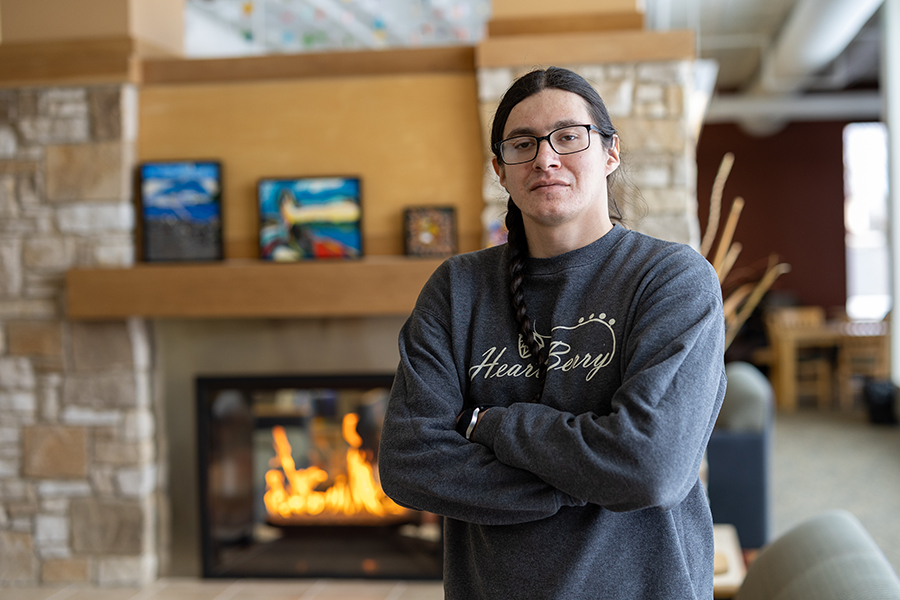
When Eric Omdahl reflects on his educational journey, he describes it as anything but linear. Growing up in the small Minnesota community of Lake Mille Lacs as a member of the Mille Lacs Band of Ojibwe, he always knew higher education would be part of his path, but the route he ended up taking was shaped by family, culture, and a deep connection to environmental stewardship.
After graduating high school, Omdahl enrolled at the University of Minnesota Duluth. But when family health concerns arose, he stepped away from school – though never from his intention to return.
That return came at Fond du Lac Tribal and Community College, a decision he describes as transformational. The college’s strong environmental science program first caught his attention, but it was the integration of Ojibwe values and cultural perspectives that made him feel at home.
“They really incorporate Ojibwe values and traditions into the curriculum,” Omdahl said, an approach that aligned with his identity and academic interests.
Discovering UW-Superior
An introduction to UW-Superior came during the St. Louis River Summit, hosted annually at the UWS campus. Witnessing students, faculty and community members collaborating on water-related research left a lasting impression on Omdahl. It was the moment that first sparked his interest in transferring.
He applied during his second year at Fond du Lac, finding the transfer process straightforward and supported. A supervisor at the college’s Environmental Institute – himself a UW-Superior alum – guided Omdahl through the experience.
Ultimately, Omdahl chose UW-Superior for its small class sizes, strong faculty connections, and its emphasis on water ecology and research partnerships.
“Working with the Lake Superior Research Institute and the Lake Superior National Estuarine Research Reserve were two aspects that really drew me here,” he said.
Life on Campus
Now a full-time junior majoring in environmental science with minors in geographic information systems (GIS) and Indigenous studies, Omdahl has quickly become an active member of the UW-Superior campus community.
He works as the administrative assistant for the Indigenous Cultures Resource Center (ICRC) and serves as president of the Native Nations Student Organization – roles that allow him to support cultural programming, organize events, and foster community for Indigenous students.
The academic transition from Fond du Lac Tribal and Community College to UW-Superior felt natural, Omdahl said. The environmental coursework he completed – along with two degrees and a certificate he earned before transferring – gave him a strong foundation and allowed him to focus more deeply on his areas of passion.
Researching the River
One highlight of Omdahl’s academic experience has been presenting research at the St. Louis River Summit – the very event that first drew him to the university. His project, developed during an internship with the Great Lakes Indian Fish and Wildlife Commission, explored the remote detection of wild rice using open-source SAR satellite imagery.
He spent months surveying wild rice beds from a canoe and learned to interpret satellite data from the European Space Agency’s Sentinel-1 program. The project not only strengthened his technical skills but connected him more deeply to culturally significant landscapes.
Presenting that work at UW-Superior was “particularly powerful,” he says – an opportunity to share knowledge at the same conference that influenced his academic path.
Tapping Into Tradition
Omdahl is also leading a new hands-on cultural project through the ICRC: establishing a campus sugarbush. Working with a small plot of land donated for educational use, he and fellow students have begun tapping maple trees and collecting sap to produce maple syrup. The project offers a living demonstration of a traditional Indigenous practice while engaging the campus community in land-based learning.
Looking Forward
After completing his bachelor’s degree, Omdahl plans to pursue a master’s degree in Tribal Resources and Environmental Stewardship. His long-term goal is to work for a Tribal natural resources agency, combining scientific training with cultural knowledge to protect lands and waters that matter deeply to Indigenous communities.
Omdahl says UW-Superior is preparing him well for that future. Coursework in water resources and ecology, paired with immersive research opportunities on Lake Superior and the St. Louis River, have solidified his sense of purpose.
Advice for Future Transfer Students
When asked what he would tell students intimidated by the thought of transferring, Omdahl keeps it simple: reach out.
“Find someone you can talk to – someone who’s been through the process,” he says. “They can help you.”