
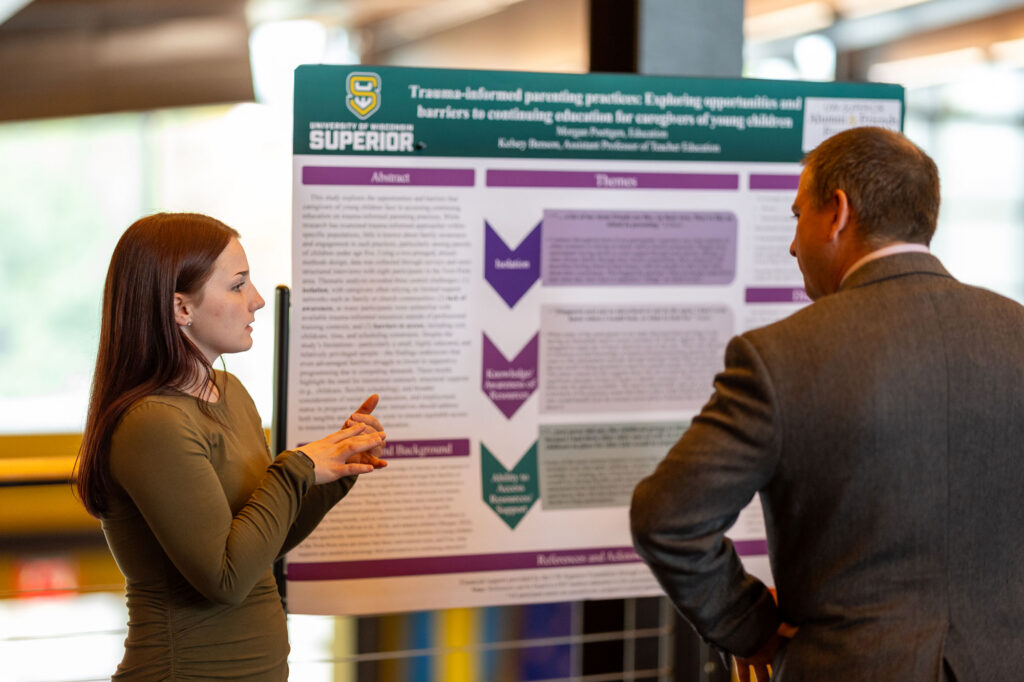
UW-Superior’s Undergraduate Research Symposium
Discover. Connect. Celebrate Research.
October 13th, 2026 | 3-6 p.m.
Fall 2026 Event Schedule
3-4 p.m. – Posters & hors d’oeuvres | Yellowjacket Union Landing
4:15-6 p.m. – Student Presentations | Yellowjacket Union Great Room A, B, C, 202, 203, & 204
6 p.m. – Symposium Closing – Thank you for Joining our Celebration
Presenters, Abstracts and Posters
Mateo Abarca | Mentor: Kim LeBard-Rankila
From Graft Maturation to Functional Recovery: The Role of Physical Therapy After Matrix-Induced Autologous Chondrocyte Implantation.

Matrix-Induced Autologous Chondrocyte Implantation (MACI) is a cell-based cartilage restoration procedure used to treat symptomatic cartilage defects of the knee. This technique combines advanced technology in both surgical and biological fields, requiring specific conditions for eligibility as well as careful consideration during the ex vivo cartilage growth process. The MACI procedure involves arthroscopic surgery to remove a piece of healthy cartilage from a non-weight-bearing area, followed by ex vivo expansion of autologous chondrocytes before seeding them onto a collagen membrane. Subsequently, the tissue is implanted into the defect, with arthroscopy being the most recently developed method. Although MACI is highlighted due to its surgical and biological mechanisms, successful recovery relies on postoperative physical therapy protocols that protect the maturing graft while restoring functional movement.
The purpose of this project is to examine MACI and explore how Physical Therapy protocols are essential for achieving successful outcomes, especially with graft maturation to achieve a successful functional recovery. The methods will include a comprehensive review of published papers regarding the MACI procedure and the importance of PT protocols such as weight-bearing progression (WB), range-of-motion progression (ROM), progressive loading, and return-to-activity timelines. Additionally, the project evaluates physical therapy outcome measures including pain, range of motion, strength testing, and patient-reported tools such as KOOS and LEFS. It also incorporates a de-identified case review from a clinical observation at Orthopedic and Neurosurgery Specialists (ONS), following a patient through MACI rehabilitation. Ultimately, this work illustrates how physical therapy supports graft protection by bridging the gap between the biology of graft maturation and practical rehabilitation milestones.
Rike Cobb | Mentor: Rachel Hodapp
A qualitative exploration into the civic engagement of young adults in Duluth-Superior
Historically, social science scholars have shown that civic engagement decreases with each new generation of young adults. Begging the question: how is this current generation of young adults experiencing civic engagement in this current sociopolitical climate in the United States? There are many societal impact such as the persistent ramifications of a global pandemic, housing instability, a climate crisis, persistent inflation, rising health care costs, geopolitical tensions and the unknown impacts of artificial intelligence that are negatively impacting this young generation’s well-being and socioeconomic status that can also influence their ability to be civically engaged. Interestingly, research shows that participating in civic engagement positively impacts the mental health of young adults while also benefiting their local communities, which is why, from a social work perspective, this study team is interested in understanding this current cohort’s level of civic engagement. Having a better understanding of young adults and their civic engagement practices in local communities helps stakeholders engage young adults and create interventions to increase engagement. To begin to make inroads into these questions, we conducted seven semi-structural qualitative interviews of young adults from the ages of 18-29 in the Duluth-Superior Metropolitan area.
Our study found that these young adults feel the pressure of today’s society negatively impacting their physical, mental, and economic health, which is fostering a sense of mistrust and disenfranchisement with larger political systems. Despite these challenges, young adults are still finding ways to be civically engaged that are unconventional but are also meaningful to them. This data invites stakeholders to meet the young adults of today where they are and to create civically engaged interventions that align with their inventive forms of civic engagement. We ask stakeholders to bring civic engagement directly to this important, overlooked, and disenfranchised population.
Hannah Copenhaver | Mentor: Emilee Howland
Did Witches Deserve the Hammer: Medieval England
Linh Dau | Mentor: Eleni Pinnow
Ethnic Identity, Acculturation, Language Use, and Homeland Visits Among Vietnamese Americans
The United States witnessed a significant increase in Vietnamese refugee migration after the end of the Vietnam War in 1975. After decades, Vietnamese Americans may have different experiences in maintaining their heritage culture while adapting to mainstream American society. In the present study, we investigated ethnic identity, acculturation, language use, and homeland visitation among Vietnamese Americans. A total of 133 first- and second-generation Vietnamese Americans completed a survey assessing ethnic identity, heritage and mainstream cultural orientations, language use, and motivations and intentions to visit Vietnam. Our results showed that first-generation participants reported stronger Vietnamese heritage cultural orientation and greater Vietnamese language use than second-generation participants, whereas the two groups did not significantly differ in mainstream American cultural orientation. Furthermore, stronger ethnic identity was also associated with stronger heritage cultural orientation. When examining homeland visit intention, we found that learning about Vietnam and connecting with Vietnamese heritage culture were the greatest motivations for visiting Vietnam. However, ethnic identity and heritage cultural orientation did not independently predict intention to visit Vietnam when examined simultaneously.
Based on the current study, our findings suggest that maintaining heritage culture and integrating into mainstream American society can occur simultaneously among Vietnamese Americans. For future research, researchers should distinguish 1.5-generation individuals from first-generation immigrants; equally important, there is a need for a longitudinal study to examine how homeland visits may shape ethnic identity and connection to heritage culture over time.
Isabella Garley | Mentor: Joel Sipress
The World War II Navajo Code Talkers
Lourd Gebregiorgis | Mentor: Khalil “Haji” Dokhanchi
Political Neutrality to Strategic Political Engagement: How Corporations Adopt or Reject Positions Based on Business Interests
This research examines the shift from corporate political neutrality toward strategic political and social engagement, focusing on how corporations balance their business interests and their social responsibility. Using Corporate Sociopolitical Activism (CSA) as a framework, the study examines corporate responses to the 2020 Black Lives Matter movement and the later debate surrounding corporate Diversity, Equity, and Inclusion (DEI) initiatives. The cases of George Floyds, Target and Costco demonstrate how consumer expectations, corporate reputation and stakeholder pressure can influence business decisions. This study also looks at consumer power through Paul Rice’s concept that purchasing decisions can serve as a form of economic participation and corporate accountability. According to Rice’s perspective, customers can influence business behavior without solely depending on political institutions or government regulation by using buying decisions as a method of accountability. My findings suggest that diversity and social responsibility can provide strategic business advantages, including strong customer loyalty, employee retention, enhanced brand reputation, and more innovation.
The response to the murder of George Floyd demonstrates the increasing engagement of companies with social issues to meet the ever-changing stakeholder expectation. In contrast, Targets experience highlights the risks of backtracking already established DEI initiatives, while Costco’s approach illustrates how maintaining inclusive practices can align with a business’s long-term goal. My findings further demonstrate that the scaling back of a company’s DEI initiatives can provide businesses with economic and competitive advantages through stronger consumer relationships, employee engagement, innovation, and brand reputation.
Renton Hamilton | Mentor: Nicholas Sloboda
Absurdism As Response to Fascism and Totalitarianism in Mid-Twentieth Century Plays
Gianna Hopke | Mentor: Hector Landa
Pedagogical Leveling of Cornelius Gurlitt’s Solo Piano Works
The purpose of this research project was to bring about the accessibility of Cornelius Gurlitt’s teaching pieces for solo piano by compiling, analyzing, and assigning pedagogical levels to selected works from titled collections. Individual pieces were selected based on musical character and value, provided with commentary on technical and musical attributes and challenges, and then assigned a level 1-10 based on those used in Dr. Jane Magrath’s Masterwork Classics series.
The result of this project was the leveling of over 100 of Gurlitt’s pieces for solo piano, compiled into a single document for easy access by music teachers and performers. This process brought to light many little-known scores worthy of teaching and study by providing previously nonexistent information on technical and musical characteristics in addition to placement within the repertory of pedagogical solo piano pieces.
Sharan Kanugovi | Mentor: Kelly Peterson
Understanding the Impact of the Blatnik Bridge Closure on Local Businesses in Superior
The Blatnik Bridge (I-535) is scheduled to close in 2027 for up to five years, rerouting its 32,500 daily vehicles to the Bong Bridge, where traffic is forecast to rise from 18,500 to 59,000 vehicles per day, and through Superior’s main commercial corridor on US 2/Belknap Street. Local businesses widely expected severe revenue losses. This study tested that expectation against measured evidence: 315 point-of-sale transactions with customer ZIP codes from a downtown bookstore, intersection-level forecasts from the Wisconsin Department of Transportation’s Traffic Management Plan, and regional surveys of 126 businesses and 581 consumers. A revenue exposure model multiplied a business’s revenue by its share of sales during congested peak hours, a published pass-by share for its category, and the change in traffic physically able to turn into the site. The evidence did not support the expected losses. Even assuming every affected customer was lost outright, at-risk revenue for the case business was 5.8 percent (95 percent confidence interval 1.8 to 10.9 percent), while one in five surveyed businesses expected losses above 25 percent. At the three intersections where the traffic plan removes or restricts left turns, total traffic rose 27 to 54 percent while traffic able to reach adjacent businesses fell 17 to 40 percent. The plan also depended on 15 to 30 percent of detoured traffic avoiding the corridor entirely. Consumers who expected to cross the bay less often were five times more likely to cut trips to Minnesota than to Wisconsin, keeping in Superior spending that currently flows to Duluth.
These results suggest that a business’s position on the corridor, rather than traffic volume, determines its exposure, and that Superior’s larger risk is businesses retrenching against losses the data did not support. Findings are limited to one destination retailer observed over four weeks.
Keywords: bridge closure; retail exposure; transaction data; traffic management; cross-border shopping; Superior, Wisconsin.
Yuu Kato | Mentor: Khalil “Haji” Dokhanchi
How Beauty Standards Sustain Consumption in the Fashion and Beauty Industries
In today’s world, beauty ideals are communicated through different forms of media, which may reinforce beauty standards and contribute to lookism. This research examines how corporations within the “beauty industries” in Japan communicate and reinforce beauty ideals through different media channels and how these messages are connected to consumption. Using qualitative content analysis, media content targeting Japanese consumers, including corporate websites, social media, and advertisements, was classified into four models based on communication channels and analyzed using a common coding framework. Social media posts and interactions were also examined to see how beauty-related messages may circulate among individuals. The analysis identified four major findings. Similar beauty characteristics appeared repeatedly across different sectors; beauty was presented not only through physical characteristics but also through values such as cuteness, femininity, naturalness, and cleanliness; products and services were consistently presented as ways to achieve desired beauty or address appearance concerns; and beauty-related evaluations were also shared and circulated through social media interactions.
These findings suggest that the repeated communication of particular beauty ideals may contribute to their normalization as beauty standards and may reinforce appearance-based bias and lookism. They also suggest that beauty ideals may be associated with broader social expectations, including femininity. Overall, this research suggests that corporations within the “beauty industries” may sustain consumption by repeatedly communicating particular beauty ideals and presenting products and services as ways to achieve them.
Arpanjot Kaur | Mentor: Surina Fnu
Parkinson’s Disease Prediction Using Machine Learning
The project proposes a machine learning approach for the classification of patients as having Parkinson’s or healthy. Firstly, the large number of features in the original data set (755 features) was reduced to 30 selected features using feature selection. Second, class imbalance was overcome by random oversampling to create a balanced training set. Thirdly, three classification algorithms, Logistic Regression, XGBoost and Support Vector Classification, were trained and evaluated on confusion matrix and classification reports.
The results indicated that Logistic Regression had better generalization on unknown data and was good at distinguishing between healthy individuals. For the final model, 30 features were selected for classification between Parkinson’s disease patients and normal. It is shown that machine learning can be used to classify patients with Parkinson’s disease, and the importance of feature selection, class balancing and model validation is emphasized.
Keywords: Parkinson’s Disease, Random Oversampling, Logistic Regression, XGBoost, Feature Selection
Hyejun Kim | Mentor: Kristopher McConnell
Investigating the Role of SOD (Superoxide Dismutase Gene) in Ultraviolet (UV) Radiation Resistance Using Drosophila Melanogaster
Ultraviolet (UV) radiation can induce oxidative stress with the production of reactive oxygen species (ROS), which can damage cellular components and impair cellular function. Superoxide dismutase 1 (SOD1) is an antioxidant enzyme that contributes to defense against oxidative stress. This study investigated whether overexpression of SOD1 improves survival post-UV exposure in Drosophila melanogaster. Using the GAL4/UAS system, flies were made to overexpress either D.melanogaster or Homo sapiens SOD1, and their survival after UV exposure was compared with wild-type flies (regular expression of SOD1). Adult flies of each strain (overexpressing D. melanogaster and H. sapiens, non-overexpressing D. melanogaster, and H.sapiens) were separated by wing phenotype and sex, exposed to UV radiation for 15 minutes, and monitored for survival for 15 days. Survival decreased over the span of 15 days following the UV exposure. However, both D. melanogaster and H. sapiens SOD1 overexpression showed no consistent survival advantage.
Overall, SOD1 overexpression did not provide a significant survival advantage against UV exposure under the conditions it was tested. Differences observed between control crosses may suggest that different pigmentation and genetic background might also influence post-UV survival. Further studies with greater replication and standardized observation schedules, and additional methods of measuring UV-induced damage may be needed to further clarify the effect of SOD1 overexpression against oxidative stress.
Diya Lohani | Mentor: Jared DeVries
Using Machine Learning to predict Resolution time at UW-Superior IT Help Desk Tickets
This study examined if machine learning would be able to recognize patterns in past University of Wisconsin–Superior IT Help Desk ticket data and be able to predict the time it would take to resolve the ticket. Around 16 thousand tickets were collected and cleaned from 2022-2026, for analysis. Some of the details in the ticket relevant to the study were priority, assigned team, category, creation time and resolution time. New features were added to represent ticket timing and workload, such as the month the ticket was created, how many tickets are opened in the same team and how many are opened with the same or higher priority. A variety of machine learning techniques were developed and tested: linear regression, decision tree, random forest and a random forest model with a small feed-forward neural network. The models were trained on one set of data and tested on another to assess the models on unseen ticket data. The decision tree had a mean absolute error of 274.74 hours, a root mean squared error of 689.23 hours, and a coefficient of determination of 0.182, which was the best performance among the directly comparable models. The random forest and random forest + neural network models did not outperform the decision tree.
In general, the findings demonstrated that machine learning could capture some meaningful patterns in the ticket resolution time, yet the number of ticket features and workload features provided in the tickets were not enough to make highly accurate predictions. The results indicate that there are other factors at play that are not sufficiently represented in the current data set that affect resolution. Further research might include more detailed data, including ticket content, issue complexity, staff members’ availability, etc., to enhance prediction accuracy and aid in better IT planning and resource management.
Geraldo Maldonado | Mentor: Amanda Goetsch
Closing the Data Gap: Improving Prescribed Fire Reporting to Evaluate Climate Change Impacts in the United States
Wildfires in the United States (US) pose increasing challenges to environmental quality, economic stability, and public well-being. This study examines the relationship between wildfire activity, suppression costs, anthropogenic climate change (ACC), and prescribed (Rx) fire as a strategy for wildfire risk reduction and climate adaptation. Historical wildfire data from the National Interagency Fire Center were analyzed to identify long-term trends in wildfire frequency, acreage burned, and suppression expenditures. Additional Rx fire data were examined to evaluate patterns in Rx burning and the availability of Rx fire as a fuel-management strategy. From 1983 through 2025, approximately 3 million wildfires burned 228 million acres in the US, with an average of approximately 70,000 fires and 5.3 million acres burned annually. Large fires exceeding 40,000 acres represented 0.05% of total wildfires in the US but accounted for 53% of total acres burned (79.2 million), 24% of suppression costs ($155.5 million), and, at the maximum, 242 days to contain. Rx fire was substantially less expensive per acre than wildfire suppression while also reducing hazardous fuel accumulations and wildfire intensity. However, ACC is expected to narrow the environmental conditions suitable for safe and effective Rx burning, creating additional challenges for maintaining treatment capacity as wildfire risk increases. Research examining the western US, where wildfire activity is disproportionately concentrated, found that approximately 2°C of global warming could reduce the number of days suitable for Rx fire by approximately 17%, with particularly large reductions during spring and summer.
These findings indicate that expanding Rx fire capacity, while maintaining appropriate protections for air quality, public health, endangered species, and natural resources, may be an important component of a broader strategy for reducing wildfire risk and adapting to changing fire conditions in the US.
Preston Meys | Mentor: Julie Gard
No Straight Lines
No Straight Lines: Poetry on Trans Archives, Art, and Experiences is a chapbook of poems created by exploring university archives in the Midwest region, historical resources available online, and textual resources featuring queer and transgender-themed poems as well as poems written in the ekphrastic style. Poems featured in the chapbook explore trans people’s history across the United States and are inspired by visual art created by or depicting trans people. The 22 poems in the chapbook are ordered so that they illustrate a struggle with identity and accepting oneself and one’s community at the start of the collection, while poems that discuss full self-acceptance and celebration of trans identities are positioned at the end of the collection, creating a narrative arc that follows the discovering and acceptance of one’s transgender identity.
Jessica Moore | Mentor: Gloria Eslinger
A Creative Intervention for Healing Generational Trauma Through Art-Journaling
Family dysfunction and trauma can be passed down through generations, leading to adverse childhood experiences that set an unsteady foundation for individuals building relationships and trying to thrive in life; this stress can contribute to major health issues across the lifespan and is associated with premature mortality. This project explored how a creative, self-paced art therapy workbook can address the effects of generational trauma and adverse childhood experiences.
The research conducted included peer-reviewed journals, published studies, and books written by professionals on childhood development, attachment theories, family systems, trauma responses, emotional regulation, and patterns carried into adulthood. Research on the science of journaling, art therapy, creative expression, and neuroplasticity was also examined to understand how these approaches informed the development of the workbook.
Based on the findings, a workbook was curated to guide users through a progression of understanding their childhood experiences, recognizing how generational patterns shaped them, identifying how those patterns may affect their relationships with themselves and others, and beginning to create healthier patterns through repeated practice. The workbook combines educational content with journaling, therapeutic coloring, creative expression, self-reflection, and emotional regulation activities. Through this process, users are encouraged to build self-awareness, recognize triggers and emotional responses, develop healthier coping strategies, and practice new behaviors over time. The resulting workbook provides a creative, self-paced resource designed to help individuals understand the connection between past experiences and present patterns while taking active steps toward change.
This project demonstrates how research on generational trauma and creative approaches can be applied to create an accessible, research-informed resource. Rather than presenting healing as a linear process, the workbook emphasizes education as empowerment, while self-reflection, creative expression, and continued practice may support people in understanding inherited patterns and developing healthier ways of responding.
Manuella Mvondo De Fouda | Mentor: Alexandra Crum
Are Commercial Soursop Products Really made from Soursop? Investigating Product Authenticity Through DNA Barcoding
Annona muricata, commonly known as soursop, is a popular ingredient in teas and dietary supplements. Therefore, verifying its botanical identity is important for ensuring consumer safety and product authenticity. This study examined commercial products labeled as A. muricata to determine if they contained detectable A. muricata DNA. Tea bags, tablets, and capsules were collected from commercial products, ground when necessary, and DNA was extracted using a plant DNA extraction kit. The internal transcribed spacer 2 (ITS2) region was amplified using a polymerase chain reaction (PCR) and analyzed by Sanger sequencing. The obtained sequences were compared with reference sequences from the National Center for Biotechnology Information database to infer phylogenetic relationships. Of the products analyzed, only Sample 3 was confirmed to contain A. muricata DNA. In contrast, although Sample 1 was labeled as A. muricata, it was identified as Taraxacum sp. (dandelion), indicating a discrepancy between the labeled and detected botanical identity. The remaining samples produced visible PCR products, but their sequences were either degraded or unsuitable for reliable identification.
These findings demonstrate that DNA barcoding can help identify inconsistencies between the stated botanical identity of commercial soursop products and the species actually detected. The results also highlighted the challenges of DNA degradation in processed plant products, which can prevent successful sequencing and species identification. Despite these limitations, DNA barcoding is a useful approach for verifying the botanical identity of commercial products and identifying potential mislabeling.
Eric Omdahl | Mentor: Hannah Nicklay
Muskrat population and Manoomin interactions in Pokegama Bay
Manoomin or northern wild rice (Zizania palustris) is an ecologically and culturally significant wetland plant in the Great Lakes region. Wild rice beds provide habitat for many wildlife species and are culturally significant to the Anishinaabe people. Muskrats (Ondatra zibethicus) often occupy the same shallow emergent wetlands where Manoomin grows. However, muskrat-Manoomin interactions remain understudied. Muskrats may affect wild rice directly by feeding or moving through the rice beds, or indirectly by their habitat engineering and feeding on other emergent vegetation.
This research examines muskrat activity in and around Manoomin in Pokegama Bay of the St. Louis River estuary. I am using trail camera monitoring, field observations of the muskrat den, travel routes, GPS documentation, and habitat observations to identify where muskrats occur and how they use the wetland habitat. The project will document each muskrat event captured via trail camera and classify it using a standardized format. This study will provide preliminary information on muskrat-Manoomin interactions and may support future Manoomin research and stewardship.
Jennifer Pike | Mentor: Lynn Goerdt
Improving Mental and Physical Well-Being of Veterans with PTDS in Superior, Wisconsin
Marquita Rios-James | Mentor: Rachelle Stone
Rebuilding Students’ Learning Power: A Critical Analysis of Cognitive Redlining and Instructional Equity
Kayanna Ruberg | Mentor: Meg Chrusciel
From Jim Crow to Today: Homeownership and Black-White Equity
Alexis Rudnicki | Mentor: Eleni Pinnow
Better Together: Housing Domestic Violence Survivors and Their Companion Animals
Rodrigo Sarabia Garcia | Mentor: Lorena Rios Mendoza
Proposal to Implement Infrared (IR) technology to Enhance Plastic Debris Recycling at the University of Wisconsin-Superior
This project investigates the generation of microplastics throughout the plastic recycling chain and evaluates how this issue is represented in Spanish and international literature. Fieldwork was conducted at different waste management and one plastic processing facilities in Madrid, Spain, including the Valdemingómez Technology Park, two municipal garbage truck stations, a plastic bin manufacturing facility, and a recycled plastic pellet plant. Direct observations revealed that microplastics can be generated at multiple stages points of the recycling process, including collection and transportation, material handling on conveyor belts, and during shredding, washing, melting, cooling, and pelletizing operations. Mechanical abrasion, friction, pressure, and thermal stress were identified as key factors contributing to the formation of small plastic fragments, even within controlled industrial environments. To complete these observations, a literature review of Spanish environmental sources and international scientific publications from 2000 to 2025 was conducted. The review demonstrated a clear increase in attention to microplastic generation associated with recycling processes, particularly after 2015. By combining firsthand field observations with published research, the study provides a realistic view of the complexity of recycling systems as both a solution to plastic waste and a potential source of secondary microplastics.
The findings highlight the importance of improved monitoring programs, density based sorting, and infrared based sensors to reduce microplastic generation. Furthermore, this study identifies critical opportunities for future research and practical strategies to minimize microplastic release within recycling processes.
Binazir Sherbekova | Mentor: Ethan Christensen
From Silicon Valley to Silk Road: Cash, Cards, or Clicks?
How Payment Methods Shape Consumer Behavior in the United States, European Union, and Central Asia
How we pay changes how we shop. Payment is not just a mechanism to make purchases anymore, and choice of payment system used by a consumer can affect consumer’s perception of goods or services. This paper studies impact that changing payment systems have on consumers and marketing strategies in the United States, EU, Kazakhstan, and Uzbekistan from 2020 to 2023. Using comparative analysis, study analyzes evolution of payment systems, such as cash payments, credit/debit cards, mobile wallets, and QR codes, as well as behavioral approach of the “pain of paying”.
According to results obtained, different payment systems are utilized by different regions depending on traits of economic situation, technological development, and others. In the United States, there is constant trend in use of card payments, which indicates shift towards convenient and digital purchases. European Union also shows diversity in payment systems, moving from cash to cash-card-online payment combination. In Central Asia, Kazakhstan and Uzbekistan use a large share of debit cards, but there is fast-growing tendency in using mobile payments and QR codes. Research outcomes have also revealed some chances where companies could adapt their marketing policies according to their payment preferences with the help of cashback offers, loyalty schemes, Buy Now Pay Later (BNPL) scheme, and digital payment schemes. Generally speaking, payment systems go beyond the concept of transactions and can affect consumer experiences and behavior.
Oreoluwa Sofolahan | Mentor: Kristopher McConnell
Exploring the Toxicity and Mutagenic Properties of Hair relaxer chemicals
Hair relaxers are cosmetic products widely used to permanently straighten tightly coiled or curly hair, particularly among Black women and other women of color. Repeated exposure to hair-relaxer chemicals has been associated with adverse health outcomes, including certain cancers, but the potential genotoxic effects of these chemicals remain poorly understood. Previous research in our laboratory using the Ames test demonstrated mutagenic effects following hair-relaxer exposure. This study investigated whether hair-relaxer exposure increases genetic damage in Drosophila melanogaster using the somatic mutation and recombination test (SMART) assay. We tested hair-relaxer activator at serial dilutions of 1:50, 1:250, 1:1250, and 1:6250 in 10 mM sucrose solution and compared the treatments with an untreated control. We monitored Oregon R flies for growth, development, and survival to identify a concentration suitable for SMART testing. We then crossed virgin flr³/TM3 serrate females with mwh males and exposed F₁ offspring to the 1:6250 dilution. We examined adult fly wings microscopically and scored single and twin spots as indicators of somatic genetic damage. Increasing activator concentrations produced observable effects on larval growth and development, including reduced growth and developmental delay. The SMART assay also showed a higher percentage of mutant spots in exposed flies compared with the control, suggesting increased genetic damage following hair-relaxer exposure.
These preliminary findings suggest that hair-relaxer activator may contribute to developmental toxicity and mutagenesis in D. melanogaster. Further experiments and statistical analyses are needed to determine the significance of these effects and investigate the potential role of CYP-mediated metabolism in hair-relaxer-associated toxicity and mutagenesis.
Rang Son | Mentor: Steven Rosenberg
The Eisenbud-Green-Harris Conjecture in Characteristic
The study of Hilbert functions of homogeneous ideals is a central topic in commutative algebra and algebraic geometry. The Eisenbud–Green–Harris conjecture states that if a homogeneous ideal I⊆R=K[x_1,…,x_n ] contains a regular sequence of degrees a_1,…,a_n, then H_(R\/I)=H_(R\/J) for some lex-plus-powers ideal J . In this work, we investigate this conjecture and provide a direct proof of the known two-variable case R=K[x,y] over an arbitrary field K . By setting d_j=dim_K〖I_j 〗 and δ_j=d_(j+1)-d_j, we analyze ker〖φ_j 〗, where φ_j : I_j⊕I_j→I_(j+1) sends (f,g) to xf+yg . Specifically, we prove that if I is generated in degree m , two degree-m generators form a regular sequence, and I_m≠R_m, then dim_K〖I_(m+1) 〗≥dim_K〖I_m 〗+2. Using this inequality, we compare δ_j with the corresponding values for a lex ideal, and generate a lex-plus-powers ideal J=L+(x^(a_1 ),y^(a_2 ) ), where L is a lex ideal, such that dim_K〖I_j 〗=dim_K〖J_j 〗 for every j . Consequently, we obtain the equality H_(R\/I)=H_(R\/J) in every degree.
Alyssa Stenersen | Mentor: Eleni Pinnow
Rural Access to Mental Health Care for Adolescents and the Effects a Community-Based Solution has on Improving Individual Outcomes
Owen Summers | Mentor: David Potter
Effects of music education and use of music throughout primary and secondary schooling
Many have established the benefits of formal and informal music education. Simultaneously, from a policy perspective, the use of mobile devices has often been discouraged in schools, thus leading to a reduction in mobile device usage in classrooms. However, few studies have examined the use of mobile devices in music education settings using a lens of policy analysis. Therefore, the purpose of this study was to examine the benefits of formal and informal music learning, including the use of mobile devices, along with the potential impact of Act 42 in relation to music learning. Using Green’s (2008) conceptual framework of formal/informal music learning, I conducted a thematic review of literature and conducted a policy analysis through the lens of intended/unintended consequences (Stone, 2012). Music education has consistently been shown to improve students’ grades and standardized test scores compared to those of students who do not participate in music programs. Additionally, in my review of literature, I found that phones could be used to enhance the well-being of students in both music and non-music classes by providing engaging learning opportunities and helping students focus through listening to music when appropriate. In regard to Act 42, teachers may benefit from utilizing the exceptions found in the policy, as many concerns surrounding phone use, while valid, can be addressed by teaching students how to use their phones responsibly and by leveraging technology to further improve classroom instruction.
Based on the review of literature and analysis, I recommend that music be taught to all students because it can improve focus and test performance. Additionally, allowing the educational use of phones can increase student engagement and contribute to the overall well-being of both the classroom and the school environment. Therefore, implementation of Act 42–including the use of exceptions in the policy–should be considered in light of the demonstrated benefits that phones can provide when used appropriately for educational purposes.
Dream West | Mentor: Carina Barker
Academic Difference Within Fostered Youth Compalted to Their Non-Fostered Peers
Presentation Schedule
If you are having trouble seeing the schedule, view it here.
Brought to You By:



2027 Undergraduate Research Symposium
Ready to pursue your research?
Turn your ideas into meaningful research, scholarship or creative work with the support of a faculty or staff mentor. Learn more about SURF