
TYPE
TOPIC
A new online MSW program blends mindfulness, justice, abolitionist and professional resilience
When the University of Wisconsin-Superior set out to build a new online Master of Social Work (MSW) program, it didn’t begin with a template. It began with people.
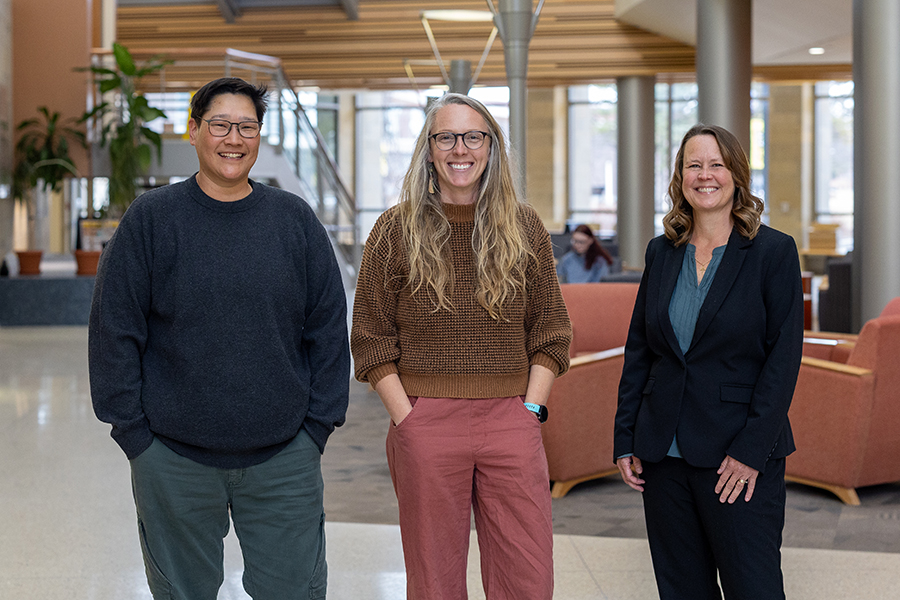
Three new faculty members – Shawyn Domyancich-Lee, Carina Barker and Rachel Hodapp – joined UW-Superior at a rare moment: the chance to help design a graduate program from the ground up. Together, they are shaping an MSW grounded in holistic wellbeing, professional resilience and justice-oriented practice, with a strong emphasis on rural and community-based care.
Building an MSW From the Ground Up
For Domyancich-Lee, MSW program director and associate professor of social work, the program represents more than a professional milestone. It reflects a deeply aligned philosophy of education, wellbeing and justice.
“I was drawn to my position with UW-Superior because of the MSW program’s connection to place-based education methods and connections to nature,” Domyancich-Lee said. “Those approaches cultivate mindfulness and wellbeing, not just for students as individuals, but for the systems of care they’ll shape.”
Barker, a teaching assistant professor of social work, described joining an emerging program as both uncommon and energizing.
“What’s been most exciting is the creativity and thoughtfulness we’ve been able to bring to the process,” Barker said. “We’re working within an accredited framework, but we’re also asking what’s current, what’s necessary and how we can move the profession forward.”
Hodapp, an assistant professor of social work who joined UW-Superior in January, inherited what she calls a rare opportunity. While the Bachelor of Social Work faculty had successfully navigated Universities of Wisconsin approval, the work of designing curriculum, pursuing accreditation through the Council on Social Work Education (CSWE) and recruiting future students was just beginning.
“It’s exciting – and a little terrifying mostly because we understand and take seriously the gravitas and enormous labor of love that building an ethical, mindful, innovative MSW program from scratch entails,” Hodapp said. “But mostly it’s exciting. It’s not often you get to build something this meaningful from scratch.”
Rethinking How Social Work Is Taught
What distinguishes UW-Superior’s MSW program is both its structure and its philosophy. Rather than replicating traditional models, faculty asked fundamental questions about the profession itself.
“Despite decades of social work practice, many individuals and systems are still deeply unwell,” Hodapp said. “We wanted to ask harder questions – why aren’t systems working as they should, and what would it look like to do social work differently?”
The result is an advanced generalist MSW that integrates mindfulness, trauma-informed care, abolitionist social work principles and nature-based approaches into a rigorous, workforce-aligned curriculum. The program is designed to prepare social workers to support individual, community and systemic wellbeing while sustaining their own professional wellness. It also encourages students to critically examine how the profession of social work has historically and currently perpetuated harm toward marginalized communities, and to envision more life-affirming systems of care.
Domyancich-Lee emphasizes three guiding pillars that consistently resonate with prospective students and community partners: mindfulness and wellbeing, place-based education and connections to nature.
“Those three features make this program truly distinctive,” Domyancich-Lee said. “They position UW-Superior to be a leader in innovative social work education.”
Three Faculty, One Shared Vision
Each faculty member brings a complementary perspective shaped by research, teaching and lived professional experience.
Barker has nearly 15 years of experience in social work education, including prior teaching at the University of Minnesota Duluth. In 2022, she opened a private mental health practice in Superior – work that directly informs her teaching.
“Having a practice here helped me understand this community and what’s needed from mental health providers,” Barker said. “It’s shaped how we think intentionally about preparing future clinicians for this region.”
With 20 years of teaching in social work education at several different institutions including the University of Minnesota Duluth and UW-River Falls, Domyancich-Lee’s research examines attachment in adult Korean adoptees, with a growing focus on place attachment – the emotional and relational bonds people form with their environments. That lens carries into teaching, where environmental justice, sustainability and place-based learning are central.
“I often bring students into the natural spaces where they live, study and work,” Domyancich-Lee said. “Those experiences matter for learning and for wellbeing.”
Hodapp bridges disciplines as both a cultural anthropologist and social worker. Her research spans health, wellbeing and cultural identity, from ethnographic work in Tanzania to mixed-methods studies on reproductive health access in Wisconsin.
“The three of us come at this work from different angles,” Hodapp said. “That diversity of perspective is one of our greatest strengths.”
Designed for Working Professionals
Delivered primarily online and self-paced, the MSW program is designed for working professionals and nontraditional students. To balance flexibility with connection, cohorts will gather for three in-person retreats spread throughout their time in the program focused on experiential learning, mindfulness practice and relationship-building.
The advanced generalist structure prepares graduates to work across a variety of practice settings. Students entering with a Bachelor of Social Work can complete the degree in one year, making it an attractive option for professionals balancing work and graduate study.
“In our current mental health system, so much of the work is reactive,” Barker said. “This program centers proactive and preventative approaches – integrating environment, mindfulness and skill-building before crisis.”
A Program Grounded in Justice and Liberation
At its core, the program aims to prepare mindful and resilient social workers who lead with cultural humility and work to reimagine systems of care, particularly in rural contexts.
Abolitionist and liberatory frameworks are embedded throughout the curriculum. Domyancich-Lee noted that while mindfulness can support individual stress management, it must also confront the systems that create distress.
“Wellbeing is rooted in justice, dignity and relational safety,” Domyancich-Lee said. “When we frame mindfulness that way, it becomes a pathway to collective liberation – not just personal coping.”
Ultimately, UW-Superior’s MSW program is designed to graduate social workers who are not only skilled practitioners, but grounded, imaginative and ethically prepared to help shape more equitable futures.
MSW Program at a Glance
The UW-Superior Master of Social Work program offers a flexible online learning experience that balances convenience with meaningful skill development. Students complete online coursework alongside interactive virtual sessions and immersive weekend workshops, ensuring opportunities to practice essential clinical and professional skills while maintaining flexibility for working adults.
Graduates of accredited undergraduate social work programs may enter through the Advanced Standing pathway and complete the degree in one year. Students with bachelor’s degrees in related disciplines may apply to the Foundation program, which provides comprehensive preparation over two years of study.
Students engage in applied, real‑world problem solving that reflects UW-Superior’s strengths in rural mental health, resilience‑focused interventions, clinical practice and mindfulness‑based approaches to well‑being. These areas align with skills increasingly sought by employers across mental and behavioral health settings.
The online MSW program is expected to launch in fall 2027 enrolling the first cohort of Foundation Program students. Prospective students and community partners can learn more or sign up for updates at https://uwsuper.edu/coming-soon-master-of-social-work/