
TYPE
TOPIC
Nontraditional student Joe Wallace finds his calling in environmental science
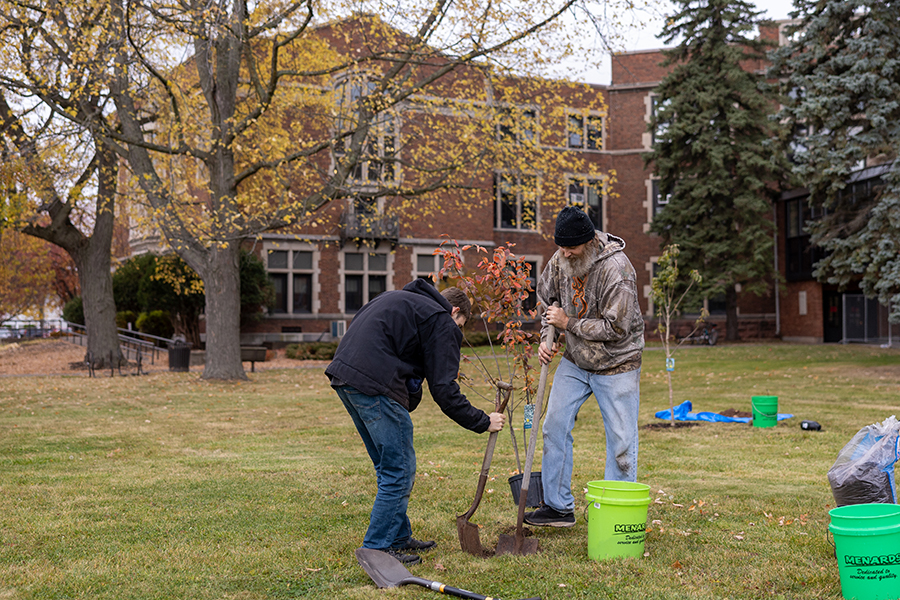
Joe Wallace is not your typical college student. At 46, the University of Wisconsin-Superior senior is a parent, a longtime blue-collar worker and, these days, something of an “elder statesman” in his academic program.
Before returning to college, Wallace worked a string of physically demanding jobs, including welding and construction, while raising his two children — daughter Jax, 14, and son Logan, 8. An injury on the job ultimately forced him to rethink his career path and prompted a long-considered pivot back to science.
“I always had science in the back of my mind,” Wallace said.
That passion has led him to a second act marked by academic success and meaningful undergraduate research. Wallace will graduate in May with a double major in biology and environmental science.
A Work Ethic Built Early
Hard work has always been central to Wallace’s life. Raised in Duluth, he grew up helping his late father, Steve, support the family through what Wallace describes as a “living off the land” mentality — hunting, fishing and gardening were part of daily life.
Wallace landed his first job at 11, mowing lawns and pulling weeds in his neighborhood, and he has been steadily employed ever since.
While his father modeled a strong blue-collar work ethic — first as an insulator and later in construction — Wallace said his mother, RaeAnn, influenced him in a different way. She returned to college later in life and earned an accounting degree. Today, she manages payroll for the St. Louis County courthouse.
“She showed me it’s never too late to go back to school,” Wallace said.
Discovering the Science That Stuck
Wallace’s fascination with science took hold early.
“Growing up, I fell in love with ecosystems,” he said. “I enjoyed tracking animals and predicting their behavior. And my 10th-grade biology class completely blew my mind.”
His interest in water quality was shaped by his surroundings along the St. Louis River.
“I always looked at the river and wondered why it looked so dirty,” he said.
At UW-Superior, Wallace’s curiosity turned into hands-on research through the Summer Undergraduate Research Fellowship (SURF) program, encouraged by his academic adviser, Andy Breckenridge. Under the mentorship of Professor Raymond Lee, Wallace studied turbidity and water clarity in the St. Louis River Estuary.
Using tools such as a Secchi disk, Wallace measured how deeply sunlight penetrates the water — a key indicator of water quality. His work earned recognition from the Izaak Walton League, which awarded him grant funding to support his research.
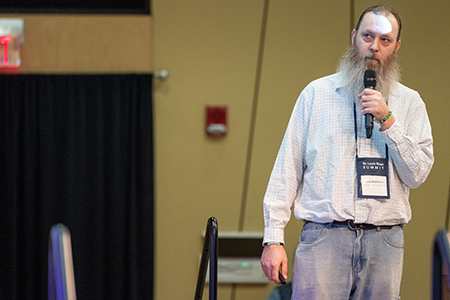
He was later invited to present his findings at the St. Louis River Summit, held on campus in March, and hopes to publish his research in an academic or scientific journal.
Faculty Perspective
Lee, assistant professor of environmental science and GIS at UW-Superior, described Wallace as an exemplary student.
“Joe is a nontraditional returning student who previously worked as a handyman, welder and sales associate at Burger King, among other jobs,” Lee said. “He did well in my introductory GIS and undergraduate research courses and caught the research bug.”
Lee mentored Wallace during the SURF program on what he called an ambitious project involving extensive water-clarity sampling.
“His work caught the eye of conservationists in the local chapter of the Izaak Walton League,” Lee said. “Joe is an exemplary nontraditional student — and an outstanding student in general.”
Looking Ahead
As graduation approaches, Wallace remains open-minded about his career path.
“I know I want to work with ecosystems, whether that’s water quality or forests,” he said. “I’m also interested in regenerative agriculture. I want to help us move forward sustainably.”
He also plans to continue his education and hopes to find an employer willing to support graduate studies.
Advice From an ‘Elder Statesman’
As one of the older students in his program, Wallace has embraced his role on campus — often with humor.
“I’m even older than some of my professors,” he said.
Wallace values the relationships he’s built with students of all ages and said he often helped classmates who were struggling.
“I don’t know that I was a role model,” Wallace said, “but I did mentor or tutor a bit when I could.”
To other nontraditional students considering a return to college, Wallace offers simple advice:
“Believe in yourself,” he said. “It’s never too late to chase your dreams — and it’s never as scary as it seems.”