
TYPE
TOPIC
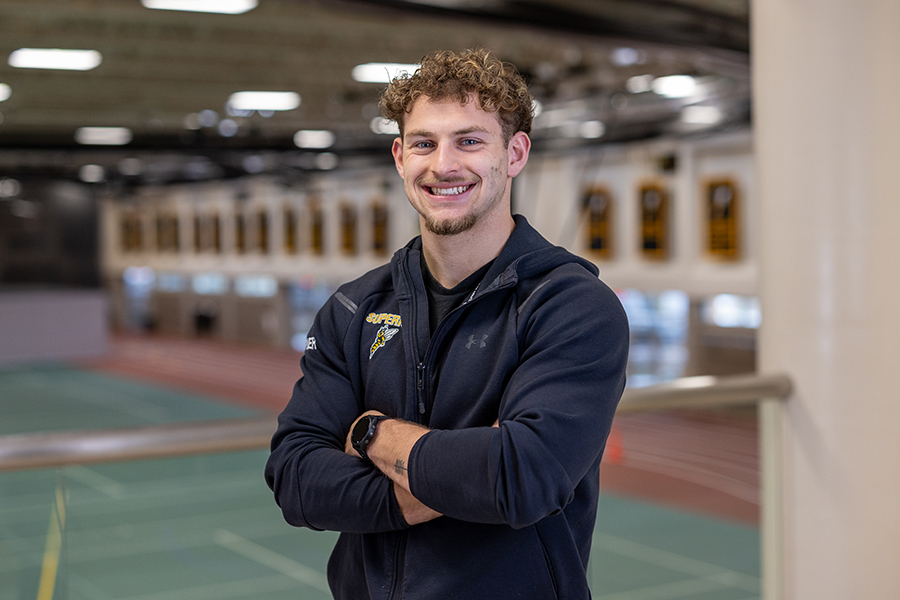
Rowan Wagner’s path to exercise science at the University of Wisconsin‑Superior is rooted in a lifelong connection to athletics – and a desire to help others stay healthy and active.
For Wagner, majoring in exercise science with a minor in health felt natural. Active in sports from an early age, he developed a curiosity about how the body works, especially after experiencing injuries himself.
“I’ve been involved in athletics pretty much my whole life, and I’m kind of injury‑prone,” he said. “That put me in the realm of strength and conditioning, athletic training and physical therapy. I’ve had so many people help me along the way, and I want to give that back to others.”
A Program Built Around Performance and Lifelong Health
UW-Superior’s exercise science program helps students understand how the human body works and how movement, health, and performance are connected. Through hands-on classes and real‑world learning experiences, students build skills in research, leadership, and assessment that prepare them for careers in health, fitness, and beyond.
Students graduate with a holistic understanding of wellness as they explore the intersection of science and human performance – preparing them for careers in clinical exercise physiology, health and fitness fields, or for entry into graduate programs such as physical therapy, occupational therapy, athletic training and physician assistant studies.
For Wagner, the curriculum has expanded his understanding beyond athletics alone.
“We’re learning how the body works – how to maximize both performance and overall health,” he said. “It’s not just about sports. It’s about helping people stay healthy for the rest of their lives.”
Looking Ahead: Prosthetics, Orthotics and Human Adaptation
That academic foundation has helped shape Wagner’s future goals. He is particularly interested in pursuing a career in prosthetics or orthotics and says his coursework has changed the way he thinks about how the body adapts to injury and limb loss.
“I’ve really learned how different parts of the body function together,” he said. “Even if someone loses an arm, the muscles can still contract. Understanding how those muscles and signals work makes it possible to control prosthetic devices.”
Opportunities to apply classroom learning are supported by facilities such as the Kessler Exercise Physiology Laboratory in UW‑Superior’s Health and Human Performance Department. The multifunctional lab allows students to conduct research and practice techniques aligned with their coursework and career interests.
Students also complete a formal capstone project, working closely with faculty mentors to synthesize theory, concepts and skills into real‑world applications – demonstrating their readiness for professional practice or further study.
Faculty Support that Makes a Difference
Now in his third year, Wagner credits UW‑Superior faculty for playing a major role in his success.
“Every professor I’ve had has been amazing,” he said. “They’ve helped me with classes, internships, job shadowing opportunities and letters of recommendation. They genuinely want you to succeed.”
That support has helped Wagner make the most of pairing his exercise science major with a health minor, which has further strengthened his academic experience.
The health minor provides a strong foundation in wellness through coursework in physical activity, nutrition, mental health and behavior change. It complements a wide range of majors and prepares students to promote wellbeing at both the individual and community level.
Nutrition, Athletics and Whole‑Body Wellness
As a student‑athlete with the Yellowjacket men’s soccer team, Wagner has seen firsthand how closely nutrition and performance are connected.
“How you treat your body outside the gym – especially through diet – has a huge impact,” he said. “Understanding how muscles work and how they need different nutrition really helps, especially when working with athletes.”
That connection between science, lifestyle and long‑term health is one of the reasons Wagner values the broad focus of the exercise science program.
Finding Community at UW‑Superior
Beyond academics, Wagner describes UW‑Superior as a welcoming environment both socially and professionally.
“My experience here has been amazing,” he said. “From my teammates and classmates to my professors and the campus environment, I haven’t regretted being here once.”
As he looks ahead, Wagner encourages students who are curious about fitness, science or health to explore exercise science.
“You’ll never know unless you try it,” he said. “If you like learning how the body works and how to keep yourself healthy, it’s a great program – not just for a career, but for your own future health.”
About the Programs
UW-Superior’s exercise science program provides the knowledge and skills to prepare you for a successful career in clinical exercise physiology, health and fitness fields. The program also lays the groundwork for entrance into graduate school for careers in exercise physiology, athletic training, physical therapy, occupational therapy, physician’s assistant and many other allied health careers.
Within UW-Superior’s health minor, coursework in physical activity, nutrition, mental health and behavior change allows students to develop practical knowledge to support personal wellbeing and promote healthier communities. This minor complements a wide range of majors and prepares students to apply health concepts in diverse professional settings. The minor – available both on campus and online – complements majors such as exercise science, sports and recreation management and related fields, enhancing your career readiness.