
TYPE
TOPIC
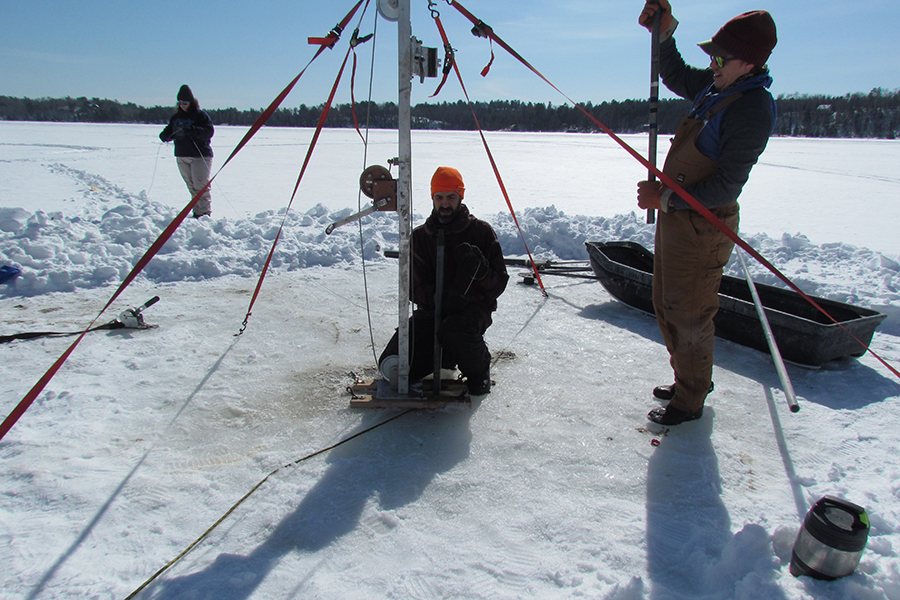
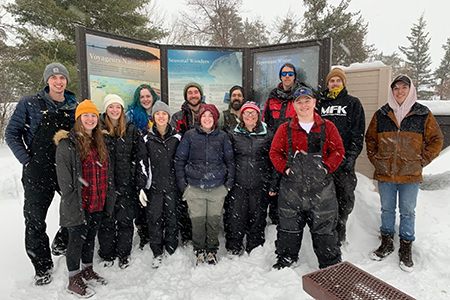
After a decade of fieldwork and analysis, University of Wisconsin-Superior Professor Andy Breckenridge and student researchers have developed a year-by-year archive of environmental change from Minnesota and Ontario, spanning one of the most climatically dynamic intervals since the last ice age.
Funded by the National Science Foundation, the study recovered more than 500 meters of lake sediment to compile a 3,600-year chronology spanning 14,400 to 10,800 years ago. The record provides rare year-by-year resolution for a period marked by rapid warming, renewed cooling and major changes along the margin of the Laurentide Ice Sheet.
That level of detail opens the door to new questions about how ice sheets, glacial lakes and regional environments changed through time — not just whether they changed, but how quickly, in what sequence and in response to which climatic events.
The varve chronology they created is one of only three long, accurately dated glacial varve chronologies in the world. The other comparable records come from northern Europe and New England. This record is unique in North America because it spans a period of abrupt climatic shifts that has attracted intense scientific interest, in part because researchers still do not know why the climate changed so quickly.
Reading ancient lakes like tree rings
During the last ice age, much of North America was covered by the Laurentide Ice Sheet. As the climate warmed and the ice melted, meltwater ponded in large lakes that collected sediment released from the receding ice sheet.
That sediment accumulated in thin annual layers known as varves. Like tree rings, each varve represents one year. A typical varve includes a summer layer, when meltwater carried sediment into the lake, and a winter layer, when the lake iced over and finer sediment settled.
Breckenridge and his team analyzed varves preserved beneath 19 modern lakes, along with two records collected by geologists more than 70 years ago. The longest of those historical records came from a former lake near Atikokan, Ontario, where the lake sediments were completely removed to develop an iron mine. The team suspected that varves were preserved deep below the modern lake sediments in many northern lakes, but those records had never been cored.
Building a 3,600-year timeline
To establish the timeline, the researchers combined several dating techniques. The most important step involved measuring individual varves from the 19 lake sites and matching their thickness patterns from site to site. Those patterns of thick and thin layers allowed the researchers to connect varves from all 19 lakes into a single chronology. Radiocarbon dating anchored the varve chronology, and additional dating from nearby glacial landforms was used to test the resulting timescale.
The completed timeline spans a particularly dynamic period near the end of the last ice age characterized by a relatively warm period known as the Bølling-Allerød and an abrupt shift to a much colder period known as the Younger Dryas. These warm and cold periods are best understood from the study of Greenland ice-core records; no comparable, high-resolution climate records exist for this period from the upper Midwest and central Canada.
A glacier that didn’t stand still
Using this record, the researchers plotted how the ice margin moved over time and compared those changes with climatic shifts recorded in Greenland ice cores. The comparison shows a highly dynamic system. The ice retreated more quickly during the Bølling-Allerød warming period, but reversed course and advanced during the colder Younger Dryas before finally resuming retreat.
The pattern itself is not surprising, but this is the first time such a tight coupling between ice-sheet behavior and climate has been visible in this region. Earlier studies relied on techniques that lacked the precision of glacial varves.
Why it matters today
Understanding how ice sheets responded to abrupt climate shifts in the past can help scientists better predict how modern ice sheets may behave in a warming world. The study provides one of the clearest pictures yet of how quickly large ice masses can react to changing temperatures.
The record also matters because annually resolved archives from this period are rare. Most dating methods can place events only within centuries, but varves can preserve the sequence of change year by year. That makes it possible to ask whether changes in climate, lakes and ice margins happened at the same time or in a specific order.
These varves may be particularly useful because they can preserve sedimentary markers that can be traced across continents or even hemispheres, including fine ash from volcanic eruptions and microscopic dust from rare cosmic or impact-related events. If those connections can be made, this varve chronology could serve as a key reference record for testing how abrupt climate changes unfolded across the Northern Hemisphere at the end of the last ice age.