
TYPE
TOPIC
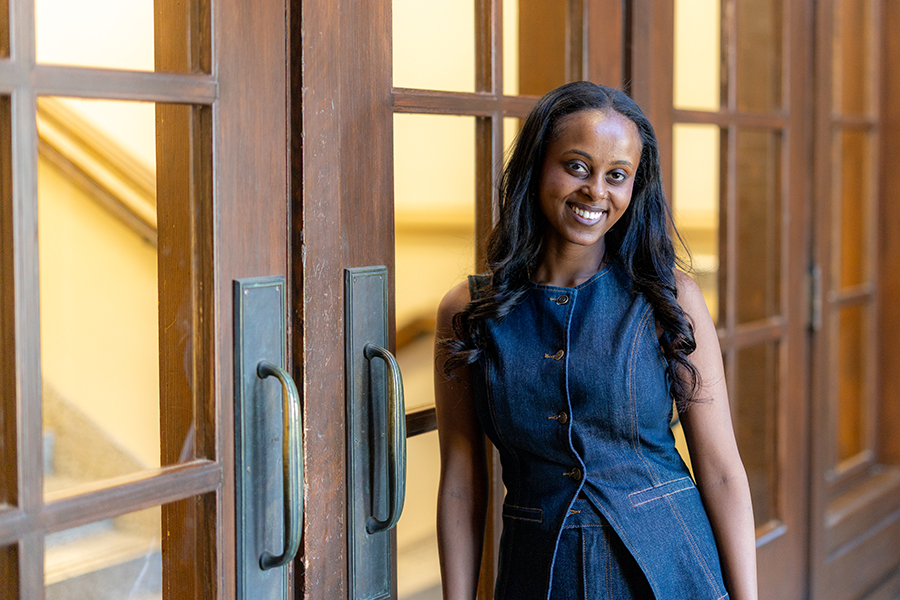
When Kidest Seabhatleabe Mitiku began searching for universities in the United States, she didn’t know exactly where she would land — academically or geographically. What she did know was that she wanted a place where relationships mattered and where she could arrive with grit and turn big ideas into greatness and real change.
“I first learned about UW-Superior while I was looking for schools around the U.S., and it popped up,” Mitiku said. “I wasn’t aware it was in Wisconsin. It said UW-Superior, and I expected it to be in Duluth.”
What ultimately drew her in was the close-knit learning environment.
“I was very much attracted by how small the classes were and how much easier it was to connect with your professors one-to-one,” she said. “After going to the website, I decided to apply, and that’s how I ended up here.”
From Ethiopia to Wisconsin
Originally from Ethiopia, Mitiku had long dreamed of pursuing higher education in the United States — a dream sparked early by media and storytelling.
“Growing up in Ethiopia, the movies we watch, all the high school TV dramas, make it look so much nicer,” she said. “It’s so appealing. It’s been my longtime dream to come to the United States and continue my higher education here.”
That dream became reality — though her arrival on campus was unforgettable for an entirely different reason.
“Oh my God, yes, I remember my first day,” Mitiku said. “I was picked up by the admissions office and dropped at my door, but I did not have my luggage.”
Not yet familiar with campus or the surrounding area, she walked around asking for help until she was directed to International Student Services in Old Main.
“So my first memory is actually here in this building,” she said. “Connecting with the International Student Office to help me get my luggage back.”
Finding Community Early
That initial sense of support quickly grew into a strong feeling of belonging, beginning with the university’s Weekend of Welcome (WOW).
“I was welcomed by international students, and that made such a difference,” Mitiku said. “The WOW program is very helpful. The students who welcomed me were involved in Student Government Association, the Promethean Club and a lot of different organizations.”
Inspired by their leadership and post-graduation paths, Mitiku became deeply involved on campus herself. She graduated May 16 having majored in public leadership and changemaking with a concentration in international humanitarian law, with minors in political science and behavioral neuroscience.
Discovering a Purpose
Her academic journey was not linear. Mitiku arrived as a criminal justice and legal studies major before discovering a passion for international policy through her coursework and faculty mentorship.
“I decided to follow in my mother’s footsteps and go into international policy, international politics and international economics,” she said. “That’s how I ended up choosing my major in change-making and policy work.”
Those interests led to research opportunities that took her far beyond the classroom. Through UW-Superior’s Summer Undergraduate Research Fellowship (SURF) program, Mitiku conducted research on international humanitarian policy and global conflicts.
Her work focuses on disarmament, demobilization and reintegration (DDR) programs for former child soldiers in Ethiopia, examining how policy can better support long-term recovery and post-conflict reintegration. She has presented her research at venues including the Wisconsin State Capitol, UW-Superior, the National Conference on Undergraduate Research in Virginia and in Washington, D.C.
“I also had the opportunity to meet a lot of legislators and different policy leaders,” she said. “Those experiences really shaped how I see my future.”
Leading on Campus and Beyond
Leadership became a defining feature of her UW-Superior experience. Mitiku served as president of the Student Government Association, where she led student-centered initiatives focused on campus well-being and access. Her work included advancing a smoke-free campus policy and helping launch a program that allows students to use their student ID to access grocery items in the campus cafeteria, addressing food insecurity.
She also served as president of the International Peace Studies Association and secretary of the Black Student Union, contributing to programs that promote global dialogue, inclusion and community engagement. In addition, she worked with the Dean of Students Office, Residence Life, International Student Services and Human Resources, and volunteered with the American Red Cross, supporting humanitarian education and resilience efforts beyond campus.
Reflecting on the impact of her work, Mitiku takes pride in knowing that some of the initiatives she helped create will continue after she graduates. “Knowing that some of my work will continue even after I leave makes me feel like I’m actually making change,” she said. “That’s been a lifelong dream for me, and it gives me more motivation to keep doing better things and make bigger changes in the world.”
Representing the Student Voice
That commitment to community and representation is also why she sought to become the Spring 2026 commencement student speaker, an honor she considers deeply meaningful.
“I wanted to be the commencement speaker because I believe I represent a large number of student groups,” she said. “We have online students, students who work full-time, veterans and nontraditional students. I’ve had the opportunity to work with many of them and hear what they have to say.”
Looking Ahead
Following graduation, Mitiku will continue her education at Columbia University’s School of International and Public Affairs, pursuing a Master of International Affairs with a concentration in international security and diplomacy.
Her long-term professional goals remain bold and deeply rooted in service.
“My goal is to work in the U.N. for about five years,” she said. “Then I want to go back to my home country and become the first female prime minister.”
As an international student, Mitiku brings a global perspective shaped by resilience, adaptability and a deep commitment to justice and humanitarian impact — qualities she hopes future students will embrace. “Everything that seems far away and unattainable is actually very attainable,” she said. “As long as we work with people and keep consistent dreams, we can reach them.”